What Is AIUC-1? The AI Agent Certification Lovable Just Earned, Explained
Frenkie
· 6 min read
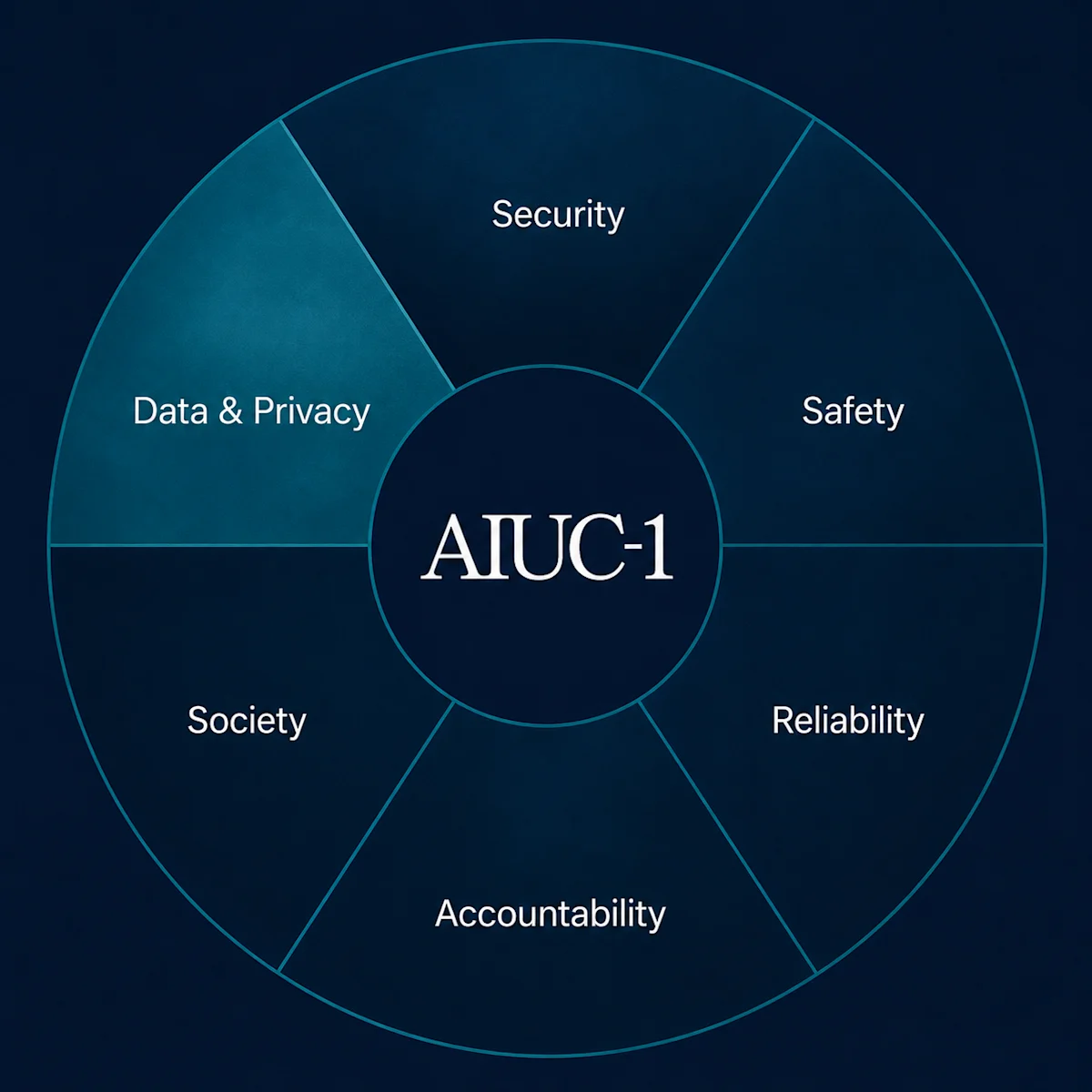
Look, enterprises have been asking the same question for two years: how do I know an AI agent is safe to deploy? SOC 2 does not answer it. ISO 42001 only partly answers it. AIUC-1 was built to answer exactly it, and the certification map just grew a new territory. On July 22, 2026, Lovable became the first AI coding agent platform to earn AIUC-1 certification.
Full disclosure before we go further: aicompliance.ai runs on Lovable's platform. We are covering this because AIUC-1 matters to every AI buyer, not because our vendor got certified. Judge the analysis on its sourcing.
Here is the certification in numbers:
Question | Answer |
|---|---|
What is AIUC-1? | The first security, safety, and reliability certification standard built for AI agents |
Who runs it? | The Artificial Intelligence Underwriting Company (AIUC), founded by AI industry veterans including Anthropic alumni |
What does it test? | 51 requirements and 130 controls across six pillars: data & privacy, security, safety, reliability, accountability, societal risks |
How is it tested? | Thousands of adversarial simulations modeled on real-world AI failures, plus quarterly third-party red-teaming |
Who audits? | Accredited third parties; Schellman was the first accredited auditor |
Who has it? | ElevenLabs (first, voice agents), UiPath (first automation platform), now Lovable (first coding agent platform) |
What makes it different? | Insurance-backed: leading insurers offer AI-specific coverage to certified companies |
What is AIUC-1 certification and who created it?
AIUC-1 is a certifiable standard for AI agents, created by the Artificial Intelligence Underwriting Company and published at aiuc-1.com. It was developed with input from Stanford, MIT, MITRE, the Cloud Security Alliance, the law firm Orrick, and dozens of Fortune 500 security leaders. Phil Venables, formerly CISO of Google Cloud and a contributor to the standard, framed the goal as "a SOC 2 for AI agents."
The standard launched in mid-2025 and has moved fast since:
Mid-2025: AIUC-1 launches; Schellman becomes the first accredited auditor.
February 2026: ElevenLabs becomes the first certified company and the first to go live with an AIUC-1-backed insurance policy for AI voice agents, after 5,835 technical tests across 14 risk categories.
March 2026: UiPath, a founding technical contributor, becomes the first enterprise automation platform certified.
June 30, 2026: the Cloud Security Alliance adds the AIUC-1 Trustmark to its STAR Registry, wiring the certification into existing enterprise vendor-assessment workflows.
July 22, 2026: Lovable becomes the first AI coding agent platform certified.
That cadence tells you something. Certifications usually crawl. This one is compounding, because it sits on top of frameworks buyers already trust: AIUC-1 crosswalks to NIST AI RMF, ISO/IEC 42001, MITRE ATLAS, the EU AI Act, and the OWASP lists rather than competing with them.
How is AIUC-1 different from SOC 2 and ISO 42001?
It tests the agent, not just the organization. SOC 2 audits your company's controls. ISO 42001 certifies your AI management system. AIUC-1 adversarially attacks the deployed AI agent itself, every quarter, and ties the result to insurance.
| SOC 2 | ISO/IEC 42001 | AIUC-1 |
|---|---|---|---|
What it certifies | Organizational security controls | AI management system | The AI agent itself |
Tests hallucinations, prompt injection, agent actions? | No | Not directly | Yes, adversarially |
Cadence | Annual | Annual surveillance, 3-year cycle | Quarterly re-testing; standard itself updates quarterly |
Verification | Auditor attestation | Certification body | Accredited audit plus third-party red-teaming |
Insurance link | None | None | Certified companies can access AI-specific coverage |
Two details deserve emphasis, and we will label the second as our own read:
The quarterly rhythm is the innovation. Annual certification made sense for infrastructure that changes slowly. AI agents ship weekly. A standard that re-tests quarterly, and revises itself quarterly, is the first one whose clock matches the technology's.
Our analytical take: the insurance backing changes audit incentives. A traditional auditor bears no cost when a certified vendor later fails. An underwriter who insures what it certifies loses money on bad certifications. That alignment is why "certification plus insurance" may prove more durable than certification alone. It is also, historically, how safety standards for electricity and automobiles matured.
Why does a coding agent need its own certification?
Because a coding agent's output executes. A chatbot that hallucinates gives you a wrong answer. A coding agent that fails ships insecure code to production, leaks a secret into a repo, or takes an action against live infrastructure with nobody watching.
Lovable's certification scope reflects exactly that difference: secure code generation defaults, secrets management, sandboxed execution, human oversight, and enterprise governance, verified by evidence rather than self-attestation, with quarterly third-party red-teaming ongoing. The announcement is day one of a security-focused week from the company, with its full white paper already public.
If you followed our coverage of the OpenAI and Hugging Face breach, you already know why unattended agent risk stopped being theoretical this month. An agent with execution permissions is an attack surface. Certification does not remove that surface. It proves someone hostile has been probing it on a schedule.
What does the "first to certify" race mean for buyers?
It means certification is becoming category table stakes, one category at a time, and the pattern is worth naming. ElevenLabs claimed voice agents. UiPath claimed enterprise automation. Lovable claimed coding agents. Each "first" turns certification into a competitive weapon inside its category, which pressures every rival to follow.
For you as a buyer, that race is good news with a caveat:
The good news: adversarial, third-party, quarterly verification is exactly what our audience has lacked when evaluating agent vendors. Security questionnaires increasingly ask about hallucinations, prompt injection, and unauthorized agent actions, none of which a SOC 2 report addresses. AIUC-1 gives those questions a checkable answer.
The caveat: a certification verifies tested behavior at audit time. It is a strong signal, not a substitute for your own controls. Certified vendor or not, you still want runtime guardrails, your own red-team pass with tools like Garak or PyRIT, and governance registration of every agent you deploy. Our governance vs compliance tools explainer covers which layer does what.
How should you use AIUC-1 in vendor evaluation?
Add it to your certification filter alongside SOC 2 and ISO 42001, and weight it highest for agentic products. A vendor holding all three has covered the organization, the management system, and the agent itself.
Four concrete moves:
Ask agent vendors directly: are you AIUC-1 certified, and if not, is it on your roadmap? The answer, and the fluency of the answer, both tell you something.
For certified vendors, request the scope. Which agents, which deployment modes, which date. A certification from three quarters ago, without the quarterly re-test, is a stale signal by design.
Check the CSA STAR Registry for the AIUC-1 Trustmark if your procurement already runs through STAR.
Keep your own layer regardless. Certification is the vendor's homework. Evaluation, monitoring, and guardrails are yours. The directory filters all of it by certification and framework, and the Finder shortlists in three questions.
Your Action Plan
The certification landscape for AI agents just got its reference standard, and three categories already have a certified first mover. This month:
Add AIUC-1 to your vendor questionnaire next to SOC 2 and ISO 42001, weighted highest for anything agentic.
Re-check your current agent vendors against the growing certified list, and ask the uncertified ones for a timeline.
Map your own agent stack to AIUC-1's six pillars as a free gap analysis, even if you never certify: data & privacy, security, safety, reliability, accountability, societal risk.
Watch for the next category firsts. Customer-support agents and browser agents are the obvious open territories, and whoever certifies first will make noise you can use as leverage in your next vendor negotiation.
The standard updates quarterly. So should your questions.