We Analyzed Google Trends on AI Compliance. The Market Rotated in 2026
Frenkie
· 6 min read
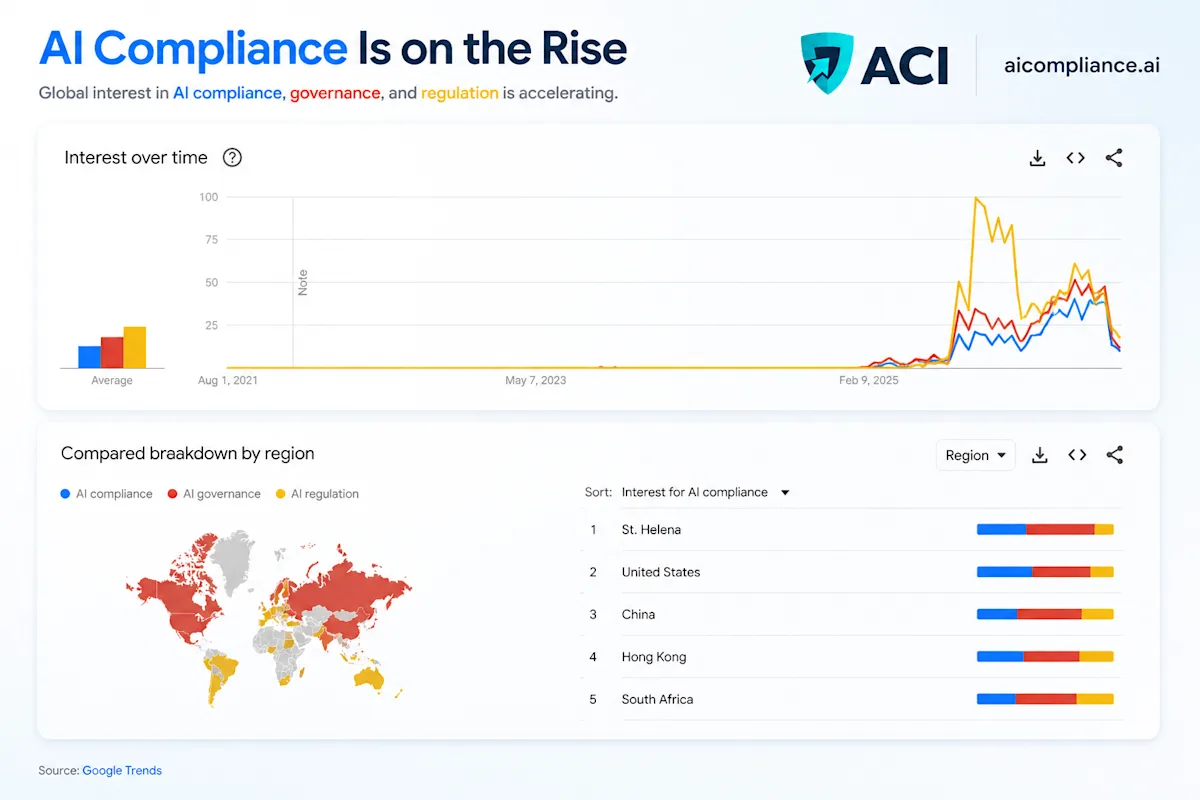
Look, the entire AI compliance category is about eighteen months old by search behavior, and it just changed shape. We pulled Google Trends data across "AI compliance," "AI governance," "AI regulation," and their related queries in late July 2026, on a five-year window. Until early 2025, all of them were effectively flat at zero. Everything you see in this market was built since.
The finding that matters is not the growth. It is the rotation inside it. "AI regulation" spiked hardest in September through November 2025, hitting the index maximum of 100, and has been falling since. Over the same months, "AI governance" and "AI compliance" climbed steadily and have now overtaken it, while "AI ethics" flatlined and drifted down.
Read that as a buyer-intent shift, not a vocabulary fashion. The market moved from "what are the rules?" to "how do I operationalize and prove this?" Confirming it: the top rising related topic attached to "AI compliance" is literally "Governance," a Breakout, and the topic "2026" is up roughly 4,200 percent. People are not asking about AI rules in general anymore. They are date-qualifying and tool-hunting.
One methodology note before the numbers, because honesty about data is the house rule: Google Trends reports relative interest on a 0 to 100 index, not search volume. Directional signals here are solid; absolute sizing is not the claim.
The movers at a glance, from our late-July 2026 pull:
Search term or topic | 12-month direction | Signal |
|---|---|---|
"AI regulation" | Peaked Sept–Nov 2025 at 100, falling since | The "what are the rules" phase is ending |
"AI governance" / "AI compliance" | Steady climb, now above "AI regulation" | The "prove it" phase is here |
"AI Act August 2026" | Vertical: roughly 15 to 100 in the final data point | Deadline-driven surge, peaking now |
"Shadow AI" | ~35 to a peak of 100 | Inventory pain going mainstream |
"AI agent security" | ~15 to ~65 | The agent era reaching security teams |
ISO 42001 variants | +110 to +140 percent off a small base | Certification demand compounding |
"AI ethics" | Flat, drifting down | The philosophical framing is losing to the operational one |
"Agentic AI governance" | Nascent, non-zero, climbing | The land-grab term with almost no competition |
What does the regulation-to-governance rotation actually mean?
It means the market matured from reading rules to buying proof. A term like "AI regulation" is a research query. "AI governance" and "AI compliance" are implementation queries, and implementation queries come with budgets attached.
The timing lines up with the enforcement calendar, and that is not a coincidence. The regulation-interest peak in late 2025 tracks the run-up to GPAI obligations taking effect; the governance climb through 2026 tracks the year companies had to turn those obligations into systems. The EU's enforcement powers and transparency duties go live on August 2, the exact moment "AI Act August 2026" went vertical in the data. Search behavior is following the deadline structure of the law almost mechanically, which is also why demand clusters around specific months in the rising-topics data rather than spreading evenly.
For anyone building or buying in this space, the practical read is in our own two-layer language from the governance vs compliance explainer: search demand rotated from the rulebook to the policy and control layers. The tools that answer "prove it" are the ones entering their demand window.
Which AI compliance topics are rising fastest?
Shadow AI, agent security, AI audit, and ISO 42001, and each maps to a concrete pain that arrived on a schedule.
Shadow AI roughly tripled to its peak, and the driver is obvious to anyone who has tried to fill in an AI inventory: you cannot govern what you have not found. Our inventory walkthrough exists because this exact search kept appearing.
AI agent security quadrupled over the year, and the OpenAI and Hugging Face incident in July will not slow it down. "Agentic AI governance," still tiny, is the term to watch: real demand, near-zero competition, which is the definition of early.
AI audit spiked sharply in May 2026, consistent with the first wave of formal assessments landing.
ISO 42001 variants growing triple digits off a small base fits the certification race we covered in the AIUC-1 explainer: certifications compound, because every certified vendor pressures its rivals to search for the same badge.
The APAC surprise: who searches for AI compliance most?
South Korea and Singapore, and it is not close. In our pull, South Korea indexes at 100 and Singapore at 96 for "AI compliance," both ahead of the United States at 69 and China at 60.
That inverts the assumption baked into almost all English-language coverage, ours included: that AI compliance demand lives in Brussels and Washington. It should not surprise anyone who tracks the laws rather than the headlines. South Korea's AI Framework Act and Singapore's AI Verify program and MAS guidance created real, dated obligations, and search demand follows obligations, as the EU data above just demonstrated. The gap is that almost no English-language resource serves these markets. We are flagging it publicly because it is true, even though it hands competitors the same map. Being the directory that takes Korean and Singaporean frameworks seriously is an open position; someone will take it.
What is everyone searching for that nobody is answering well?
The boring queries. Across every keyword set we ran, the biggest attached demand was definitional and referential, the unglamorous bottom of the funnel:
Definitions: "what is AI governance" indexes at 49 against its head term; "compliance definition" and "compliance meaning" are the top two real queries attached to "AI compliance" in the US. These are also precisely the queries AI answer engines cite, which is why definitional pillars matter more in 2026 than they did in the ten-blue-links era.
Reference utilities: "eu ai act 2026" indexes at 90, with "eu ai act pdf," "timeline," "text," and "summary" trailing behind it. Searchers want an always-current reference, not another hot take.
Regulatory crossovers: "gdpr compliance," "hipaa compliance," and "ai in healthcare" all rank as top related queries for "AI compliance." AI-meets-existing-law is where compliance officers actually live.
AI literacy: steady demand all year, and it is a real EU AI Act Article 4 obligation, which makes it the rare query that is simultaneously cheap to answer and legally load-bearing.
The number one related query everywhere: "AI news" and "AI news today" dominated the related queries for every single term we ran, from AI compliance to ISO 42001. The market wants a filtered feed of what changed, and right now that demand goes entirely to general news sites.
Transparency about our own book: this analysis is shaping our roadmap. The gaps above are the ones we intend to fill, and publishing the map anyway is the bet that being right in public beats being quiet.
Your Action Plan
Whether you build, buy, or market in this space, the data suggests the same four moves:
Speak the buyer's current language. Position against "governance" and "compliance," the proving words, not "regulation," the reading word. The rotation already happened.
Put dates on things. The "2026" topic up 4,200 percent says searchers date-qualify everything now. Content, product pages, and internal deadlines should carry the year and the milestone.
Watch APAC before your competitors do. If your product or program touches Korea or Singapore, their frameworks deserve first-class treatment, not a footnote.
Track the nascent terms quarterly. "Agentic AI governance" today looks like "shadow AI" did eighteen months ago. The directory and Finder will keep tracking the tools; the next data pull will tell us if the curve held.
The category built itself in eighteen months. The next eighteen will decide who owns the proving phase, and the search data says that race started without waiting for anyone.